European Deforestation Regulation (EUDR): What Swiss Companies Need to Know
European Deforestation Regulation (EUDR): What Swiss Companies Need to Know
What is it about?
Deforestation is one of the main causes of climate change, biodiversity loss, and ecosystem destruction. According to the IPCC- report from 2023, preventing deforestation is one of the most effective global measures for reducing CO₂ emissions and combating climate change. The EU (and Switzerland) contributes significantly to deforestation by using certain natural resources and products made from cattle, wood, rubber, cocoa, coffee, soy, and palm oil, the cultivation of which in certain regions is directly linked to deforestation. This is why the EU Regulation on deforestation-free products (EUDR) was created, which came into force on June 29, 2023, and will apply to non-SMEs from December 30, 2026, and to SMEs from June 30, 2027.

Raw materials whose production is directly linked to deforestation
What is the EUDR and what does it require?
The aim of the EUDR is to ensure that, from 2027 onwards, no products associated with new deforestation are sold in the EU. This needs to be proved via geolocation tracking using satellite images that products containing the seven raw materials mentioned above have not led to any further deforestation in this specific area as of December 31, 2020. This is intended to protect untouched primeval forests and prevent further deforestation for EU products. The EUDR requires that:
- Products are deforestation free
- Products have been produced in accordance with relevant regulations of country of production
- Products are covered by a due diligence declaration.
Who is affected by the EUDR?
The EUDR applies to businesses that
- places EUDR relevant products in the EU, or
- exports EUDR relevant products from the EU, or
- makes EUDR relevant products available in the EU markets.
The EUDR distinguishes between traders and operators, whose obligations differ. The EUDR applies to all companies, regardless of their size or the volume of goods imported/exported. However, small and medium-sized enterprises (SMEs) have fewer obligations than large companies (non-SMEs). A company is considered a non-SME if it meets/exceeds two of the three criteria:
- Average number of employees 250
- Balance sheet total 25 million Euro
- Annual turnover 50 million Euro
Are there any sanctions for non-compliance?
Yes! All EU countries have national authorities that monitor and enforce the EUDR. In Germany, this is the Federal Office for Agriculture and Food (Bundesanstalt für Landwirtschaft und Ernährung). If violations are detected, the competent authorities can take the following measures:
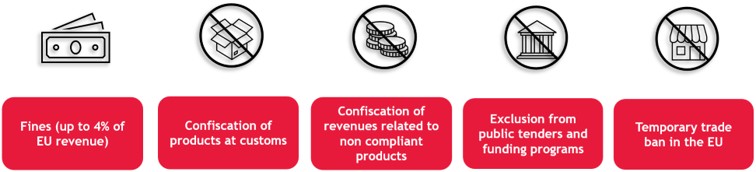
Companies that do not comply with the EUDR risk losing access to the EU market, fines, trust and reputation, as well as facing supply chain problems. At the same time, the regulation opens up opportunities: improved visibility and resilience of the supply chain, gain new customers looking for EUDR complaint products, and stronger brand value through responsible, sustainable procurement.
How are Swiss companies affected by the EUDR?
Although the EUDR is an EU regulation, it also has a noticeable impact on Swiss companies. The Swiss Federal Office for the Environment has made it clear that Swiss companies exporting EUDR-relevant products to the EU must comply fully with the requirements. However, the regulation does not apply to products sold exclusively in Switzerland.
Swiss companies may be affected by the EUDR in the following ways:
1) Swiss companies with a branch or subsidiary in the EU
Swiss companies that are based in the EU or have subsidiaries there and import or export relevant products in the EU are directly affected by the EUDR.
2) Swiss companies without an EU presence that export to the EU
Swiss companies that deliver goods to EU customers without having their own EU branch may also be directly affected – provided they have an EORI number. Without an EORI number, they are indirectly affected, as they still have to provide all the necessary raw material information to their EU customers.
3) Swiss companies that trade/sell relevant raw materials/products to EU companies
Swiss companies that trade or process raw materials and supply them to EU companies are indirectly affected. They must provide their EU partners with the necessary information so that they can comply with the EUDR requirements.
Depending on the size of the company and its role in the supply chain, EU suppliers may have less stringent obligations than Swiss suppliers – and thus have an advantage with EU customers. It is therefore crucial that Swiss companies provide the necessary EUDR data for all products they supply to the EU so that they are not excluded due to sustainability or procurement requirements of EU customers.
If your company or supply chain works with the 7 raw materials, the EUDR may affect you. This includes manufacturers, retailers, and distributors in many industries that use these raw materials. The sectors most affected are:
- Manufacturing sector- products with rubber, wood or palm oil
- Food and beverage - products with beef, soy, coffee, cocoa or palm oil
- Construction & packaging - products with wood and paper
- Textiles & fashion - products with rubber
- Cosmetics & health care - products with palm oil or rubber and its derivatives
Eight steps to prepare for the EUDR
1) Identify affected products: Create an inventory of purchased products and raw materials to check for EUDR-relevant goods.
2) Clarify roles and responsibilities: Determine whether your company is considered an operator or distributor—and what obligations this entails.
3) Establish a due diligence system: Create standardized templates for data collection and set up a suitable IT solution for managing the information.
4) Supplier Engagement: Obtain the necessary data and ensure that it is complete and accurate.
5) Perform a risk assessment: Identify suppliers that pose a non-negligible risk.
6) Implement risk-mitigating measures: Define and apply targeted measures for suppliers with standard or high risk.
7) Submit a due diligence statement: Submit the Due Diligence Statement (DDS) to the EU TRACES system to obtain the reference number for customs declaration.
8) Ensure documentation: Keep all data and results for five years; non-SMEs must also publish an annual report on the due diligence process.