What’s changing in social insurance and payroll
What’s changing in social insurance and payroll
People care about social security. We see this in how often the issue is put to the vote, the findings of the Swiss Worry Barometer, and coverage across traditional and social media. In this article, we fill you in on what you need to know for the year ahead.
Thresholds, key figures and contributions for 2027
The maximum monthly pension under Switzerland’s old-age and survivors’ insurance (OASI) scheme is set to rise by CHF 40 in the new year. As a result, all thresholds for occupational pensions under the Federal Act on Occupational Retirement, Survivors’ and Disability Pension Plans (OPA) will increase, as will those for pillar 3a. It is important to note that the 13th pension payment is excluded when calculating any threshold based on the OASI pension. You can download our popular flyer with the social insurance figures for 2027 here.
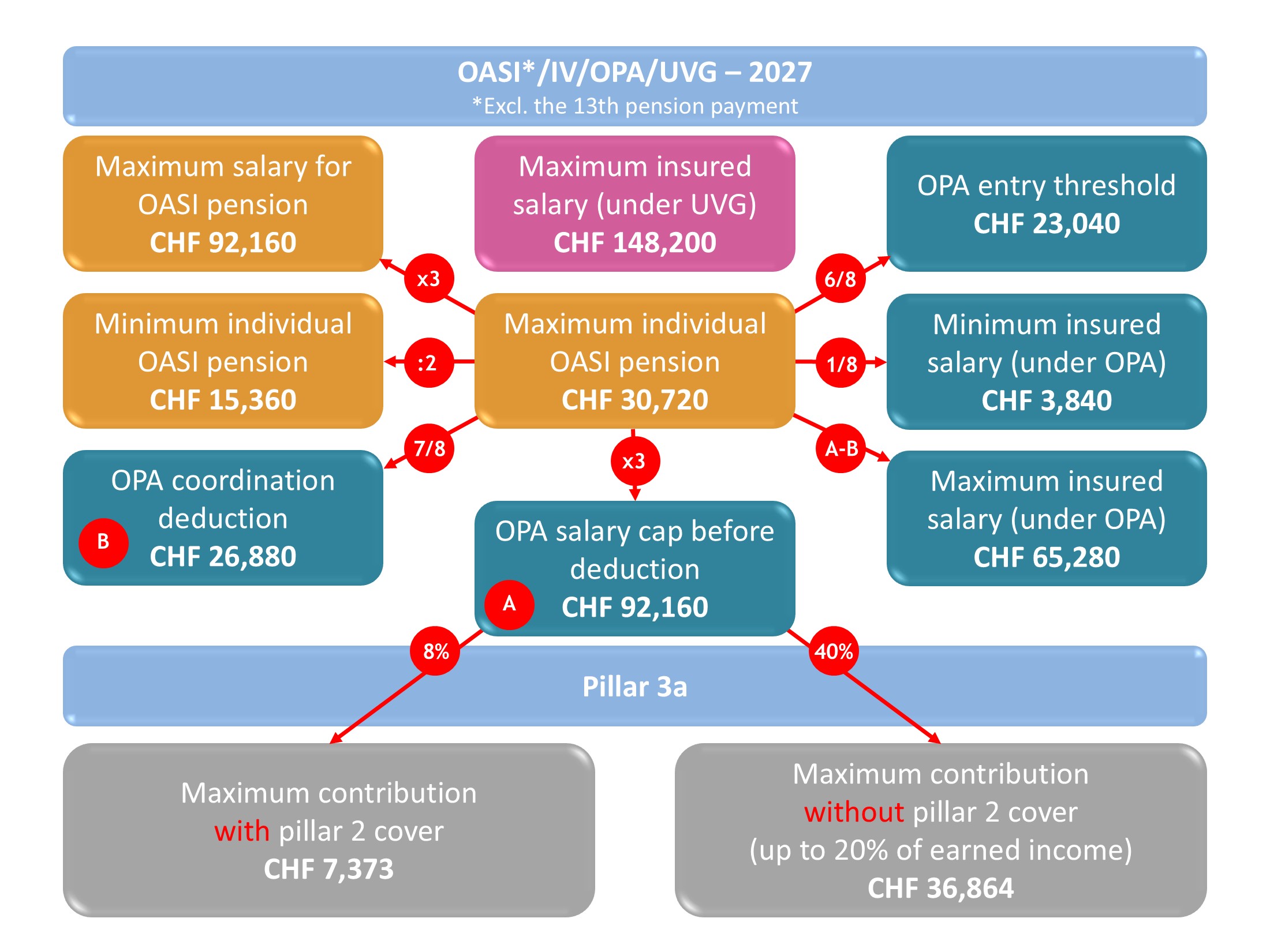
OASI
Retirement age for women
Under the OASI 21 reform, women born in 1963 reach the reference age at 64 years and nine months.
13th pension payment
As a reminder, the 13th pension payment will be made for the first time in December 2026. It will equal the average monthly pension for the year coming to a close.
Examples
Anna turned 64 on 15 March 2026. If she retires at the reference age of 64 years and six months, she will receive a monthly pension of CHF 2,460 from 1 October 2026 (based on pension scale 44). In December 2026, she will receive a 13th pension payment of CHF 615, calculated pro rata for three months.
Peter has been receiving a monthly old-age pension of CHF 2,520 since 2025. His wife also retired on 1 August 2026. As a result of income splitting and the cap on married couples’ state pensions, his monthly pension fell to CHF 1,971. In December, he will receive a 13th pension payment of CHF 2,291 (the monthly average based on an annual pension of CHF 27,495).
People who die before 1 December 2026 are not entitled to a 13th pension payment, not even on a pro rata basis.
People who are entitled to a widow’s or widower’s pension can choose whether to receive the survivor’s pension or the old-age pension. If no preference is declared, the old-age pension is paid. This matters because the monthly survivor’s pension may be higher than the monthly old-age pension. However, the 13th old-age pension payment may bring the annual total above that of the survivor’s pension, which does not include a 13th payment.
Family allowances
At the time of publication, the only known increases were in the canton of Solothurn, where the child and education allowances are set to rise to CHF 230 and CHF 280, respectively, and in the canton of Jura, where they are set to rise to CHF 295 and CHF 350, respectively. The full list of allowances for 2027 was not yet available.
The increase in the OASI pension also raises the minimum income at which parents become entitled to family allowances to CHF 7,680 per year or CHF 640 per month. Eligibility also ceases if the child for whom the allowance is payable earns more than CHF 2,560 per month.
Federal Supreme Court strengthens entitlement for people who are not gainfully employed
Under Article 19 paras. 1 and 2 of the Federal Act on Family Allowances (FamZG), people who are not gainfully employed, are subject to compulsory OASI insurance and have a low income (up to CHF 46,080 in 2027) are entitled to a family allowance from their canton of residence, provided they do not receive supplementary benefits. Article 16 letter b of the Federal Ordinance on Family Allowances (FamZV) excludes married people from this entitlement if they are not separated and their spouse receives an OASI old-age pension. In its judgment of 7 May 2026 in case 8C_667/2025, the Federal Supreme Court held that this provision could not be applied. The new case law must be applied both where no decision has yet been issued on a claim and where a decision has been issued but has yet to become final.
Loss of earnings compensation (EO) – reform effective 1 July 2027
The EO reform comes into force on 1 July 2027. The significant expansion of benefits available under the scheme may affect employees.
Abolition of child allowances under the EO scheme
As nationwide provisions on child allowances have applied since 2009, the separate child allowance under the EO scheme will be abolished. The maximum daily allowance will therefore be CHF 220 (based on an annual salary of CHF 99,000). The separate cap on total compensation including child allowances will no longer apply. The terminology will change accordingly. The basic allowance will now be called the service allowance.
The allowance paid during recruit school will rise to CHF 70 per day (32% of the maximum service allowance). For people in gainful employment, the allowance will range from a minimum of CHF 125 (57%) to CHF 220 (100%) per day.
Business allowances
Under the current rules, self-employed people performing service receive a business allowance to cover the fixed costs of a business they are actively involved in running (Article 8 of the Federal Act on Compensation for Loss of Earnings (EOG)). Under the reform, the business allowance will be payable alongside all EO benefits, with only one allowance payable per business. If a period of leave extends beyond the date the reform comes into force, any business allowance due will be paid from that date for the remainder of the leave entitlement.
Examples
Peter and Petra run a general partnership together. Petra gives birth on 15 June 2027 and goes on maternity leave. Peter begins his military service on 9 August 2027. A business allowance may therefore be payable* in the following cases:
- From 1 July, alongside the maternity allowance
- From 1 July, alongside any allowance for the other parent that has yet to be drawn
- From 9 August, alongside the service allowance
As all three cases concern the same business, only one person can apply for a business allowance for the same period.
*Eligibility must be assessed in each case.
Childcare allowances
Under the current rules, people performing service receive a childcare allowance if they can show that their service entails extra childcare costs (Article 7 EOG). Under the reform, the childcare allowance will also be payable alongside other EO benefits if, for health reasons, those entitled to the benefits are unable to care for their children for at least two consecutive days.
The childcare allowance will cover only the cost of institutional childcare, however. This includes private and public facilities that care for children before they reach compulsory school age or during their compulsory schooling. Examples include nurseries, day-care centres, school-based care centres, wraparound care for pupils, all-day schools and facilities for children of different ages. Childminders are also included, provided they are affiliated with a network or association (Article 12 para. 1 of the Ordinance on Compensation for Loss of Earnings (EOV)).
Maternity allowance (MSE)
Under the current rules, the maternity allowance is paid for an additional period of up to 56 days if the newborn has to remain in hospital for two weeks or more. An employed mother’s protection against dismissal is also extended by the same period.
Under the reform, there will be no time limit on the extension of the maternity allowance. The extension will also apply if it is the mother (and not the child) who has to remain in hospital. The mother’s protection against dismissal will be extended by the same period, up to a maximum of twelve weeks.
Allowance for the other parent (EAE)
The other parent is entitled to 14 days’ leave (formerly: paternity leave) on the birth of a child or 14 weeks’ leave if the mother dies. Under the reform, the other parent will also be entitled to leave if the child is stillborn or dies within the first 14 days after birth. In such cases, the leave must be taken in one continuous period starting the day after the stillbirth or death.
Under the reform, the allowance for the other parent will also be extended if the mother has to remain in hospital for at least two weeks. This additional period begins on the 15th day of the mother’s hospital stay, lasts for up to 84 days and cannot extend beyond the 97th day after the birth of the child. In such cases, the other parent’s protection against dismissal will also be extended for the duration of the mother’s hospital stay, up to a maximum of twelve weeks from the birth of the child.
Childcare leave allowance (BUE)
Under the current rules, parents can apply for a childcare leave allowance if they interrupt their work to care for a child whose health is seriously impaired. Unlike other forms of leave, entitlement to childcare leave depends on entitlement to the childcare leave allowance. If the compensation office turns down the claim for the allowance, the parents are also ineligible for the leave.
Under the reform, parents will also be entitled to the childcare leave allowance from the fourth day if a child under 18 has to remain in hospital for at least four consecutive days. This applies even if the child’s health is not seriously impaired, except immediately after birth. The entitlement covers the hospital stay and any medically necessary recovery period of up to 21 days. A maximum of 98 daily allowances is payable per case. Employed parents are also protected against dismissal during this period.
What HR and payroll teams should review now
Ahead of the EO reform coming into force, we recommend reviewing employment contracts, employee regulations and absence policies, and updating them where necessary. Clear HR and payroll processes help employers determine when they must continue paying salaries, for how long, and which dismissal protection periods apply.
Short-time working compensation (KAE)
The maximum period for which short-time working compensation can be claimed has been temporarily increased from 12 to 24 months. This increase applies until 31 January 2027. The waiting period is one day rather than three. Employers must cover the cost of the hours lost on that day themselves.
The Federal Council plans a gradual return to the normal arrangements over the course of 2027. In December 2026, it will consider whether to extend the maximum entitlement period again. In spring 2027, it plans to review whether to reinstate the three-day waiting period.
Accident insurance (UVG) for the self-employed
Self-employed people are not required to take out accident insurance under the Federal Accident Insurance Act (UVG), but may do so voluntarily. From 1 January 2027, the minimum income for this cover will fall from CHF 66,690 to CHF 44,460. The insurer may also adjust the income threshold for those who work part-time.
Daily sickness allowance insurance (KTG) for employees
The Swiss Insurance Association’s (SIA) revised agreement on the right of transfer between insurers (Freizügigkeitsabkommen, transfer agreement) comes into force on 1 January 2027. It introduces two changes of relevance to employers:
- Obligation to pay benefits provisionally: When an employer switches between insurers that are party to the transfer agreement, it may be unclear which insurer is responsible for an ongoing claim. Under the revised agreement, if the insurers disagree over responsibility, the previous insurer must pay benefits on a provisional basis. The amount of the insured daily allowance, the waiting period and the duration of benefits are governed by the previous terms. Once responsibility has been established, the insurers settle any reimbursement between themselves.
- Right to be assigned to an insurer: Employers based in Switzerland that, despite documented efforts and through no fault of their own, are unable to obtain group KTG for their employees under the Insurance Contract Act (VVG) may, subject to certain conditions, be assigned to an insurer that is party to the transfer agreement. In particular, they must show that they requested a quotation, but received none, from at least three VVG insurers that are party to the agreement. Once assigned, the insurer must provide a quotation. Cover does not take effect automatically.
The right to be assigned to an insurer, in particular, helps increase insurance coverage for sickness. The assignment procedure applies only to VVG insurers that are party to the transfer agreement. It gives employers a way to obtain cover if they meet the conditions of the agreement. Whether this cover can replace the employer’s obligation to continue paying salaries under Article 324a of the Swiss Code of Obligations (CO) depends, among other things, on whether it provides equivalent protection and an agreement is in place with the employees, as required. The assignment procedure does not guarantee any particular premium level.
Pillar 3a
When a person with pillar 3a savings dies, a statutory order of priority determines who receives the savings. The beneficiaries rank in the following order:
- Surviving spouse or registered partner
- Descendants, life partners and anyone to whom the deceased provided substantial financial support
- Parents
- Siblings
- Other heirs
Under the current rules, the holder can designate beneficiaries in the second rank and specify their respective shares. For beneficiaries in the third to fifth ranks, the holder can also change the order of priority and specify or change their respective shares.
From 1 June 2027, the holder will be able to include one or more people from the second rank in the first rank and specify their respective shares. Each beneficiary in the first and second ranks must receive a share of at least 10%.
Example
Karin is married and has pillar 3a savings. If she gives no instructions, her wife will receive the entire balance on Karin’s death. If Karin would like her son to receive a share as well, she must include him in the first rank. Unless she specifies their respective shares, her wife and son will each receive half of the balance. Karin can, however, specify the share each is to receive. Neither share may be less than 10%.
Annual salary certificate
At the time this article was published, we were not aware of any changes.
Cross-border employment
The European Union (EU) has adopted a reform of the rules on social security coordination and the A1 certificate. The reform provides for certain exemptions from the requirement to apply for an A1 certificate. While it came into force on 1 November 2026, the key changes concerning postings abroad, work in two or more countries, advance notification and the A1 certificate will not apply until 2 November 2028. These changes do not automatically apply to Switzerland. For them to apply between Switzerland and the EU Member States, Annex II to the Agreement on the Free Movement of Persons (AFMP) between Switzerland and the EU must be amended.
Until further notice, the existing rules therefore continue to apply. They require that an A1 certificate be applied for from the first day if a person carries out part of their work abroad (provided that the case in question falls within the scope of Regulation (EC) No 883/2004).
Conclusion and outlook
With so much on the agenda, 2027 and the years beyond look set to bring some interesting developments. The consultation on the OASI 2030 reform has concluded and the Federal Council is currently revising its draft dispatch to Parliament. The proposed reform of integration measures under disability insurance (IV) is out for consultation and includes an increase in the contribution rates. The reform of survivors’ pensions is still under discussion, as are the initiative of the political party Die Mitte to lift the cap on married couples’ pensions and an indirect counterproposal. The Family Time Initiative has formally qualified for a nationwide vote. A decision has been taken to exempt tips in certain sectors by law, and a bill to that effect is being drafted.
Keep up to date with us. We’re here to help with training courses, webinars, newsletters and individual advice. Make the most of our expertise and experience. We look forward to hearing from you!